While Christmas is so familiar that we sometimes wonder whether anything fresh and true can be said about it, there is a way to explore its meaning that may seem new to us today, yet is in fact quite traditional, dating back to the Middle Ages and the ancient Fathers of the Church.
Christmas is so familiar that we sometimes wonder whether anything fresh and true can be said about it.
But there is a way to explore its meaning that may seem new to us today, yet is in fact quite traditional, dating back to the Middle Ages and the ancient Fathers of the Church.
Modern interpreters often argue about whether a given Scripture passage should be interpreted literally or symbolically. Medieval writers would question the “either/or” approach. They thought a passage could have as many as four “right” interpretations, one literal and three symbolic.
These were: (1) the historical or literal, which is the primary sense on which the others all depend; (2) the prophetic sense when an Old Testament event foreshadows its New Testament fulfillment; (3) the moral or spiritual sense, when events and characters in a story correspond to elements in our own lives; and (4) the eschatological sense, when a scene on earth foreshadows something of heavenly glory.
This symbolism is legitimate because it doesn’t detract from the historical, literal sense, but builds on and expands it. It’s based on the theologically sound premise that history too symbolizes, or points beyond itself, for God wrote three books, not just one: nature and history as well as Scripture. The story of history is composed not only of “events,” but of words, signs and symbols. This is unfamiliar to us only because we have lost a sense of depth and exchanged it for a flat, one-dimensional, “bottom-line” mentality in which everything means only one thing.
Let’s try to recapture the riches of this lost worldview by applying the spiritual sense of the Christmas story to our lives. For that story happens not only once, in history, but also many times in each individual’s soul. Christ comes to the world — but He also comes to each of us. Advent happens over and over again.
There are two ways to connecting the historical and the spiritual senses. The Jesuit method, from St. Ignatius’ “Spiritual Exercises,” tells us to imaginatively place ourselves into the Gospel stories. The older Augustinian method tells us to look for elements of the story in our lives. We shall be using this latter method as we survey the scene in Bethlehem for the next four weeks.
Look at your Nativity set. Around the Christ Child you see four people or groups: Mary, Joseph, the wise men and the shepherds. We are all around the Christ Child, defined by our relationship to Him; we are all Marys, Josephs, wise men or shepherds.
The Shepherds
Let’s consider the shepherds first.
They are peasants: simple, hard-working, honest people. Under our layers of modern sophistication and education, we are all peasants. It’s the peasant soul in us, the child in us, that hears angels, that is hailed by the heavenly glory, that dares to hope and wonder with awe.
The shepherds are outdoors, exposed to God’s sky, not protected by human artifice. Even when we’re in an office, surrounded by technology, the shepherd-self in us is always in this situation. No place is safe from God’s invasion.
They are “keeping watch by night.” In the darkness they wait and watch, like the little child at the center of our souls. And it’s in the darkness that the heavenly light dawns. In the silence is heard the angels’ song. Kierkegaard said, “If I could prescribe only one remedy for all the ills of the modern world, I would prescribe silence. For even if the Word of God were proclaimed, no one would hear it; there is too much noise. Therefore, create silence.”
The shepherds are “keeping watch over their sheep,” as our soul watches over its body with its flock of desires, responsible for the care and direction of our herd or instincts. It’s as we go about this humdrum daily business that supernatural grace comes to us through the ministry of angels. We do not usually see them, as the shepherds did, but they are there. In heaven we will recognize them, and their role in our lives. “So it was you all the time! It was you who were there...then...”
“The glory of the Lord shone round about them.” This is the shekinah, the heavenly light that had appeared visibly over the Ark of the Covenant and on Mount Sinai. We can still see it, but only with the inner eye of faith. Only if we believe, do we see.
“They were afraid.” We fear the unknown, the opening skies, the passages between worlds, like birth and death. Even when the angel says, “Fear not,” the event is no less momentous, The awe is now joyful, not fearsome; but it’s still “awe-full.” It is “good tidings of great joy.” Joy can be as awesome as fear. The Good News, the incredible event of the Incarnation, is the most joyful and the most awesome news we have ever heard.
The angel tells the shepherds that this event is “to you.” Not just to “mankind” in general, but to us, these ordinary individuals — Almighty God comes to our fields, stables, offices and homes. This is no prerecorded message; this is God calling us up personally.
The shepherds’ response is immediate and practical: “Let us go to Bethlehem.” The angel’s message has power; it moves people to go. When Cicero addressed the Roman senate, everyone said, “How beautifully he speaks!” But they remained in their seats. Yet when Demosthenes addressed the Greek army, they leaped up, clashed spear upon shield and said, “Let us march!”
The angels are like Demosthenes. Scholars, seeing angels, say, “Let us interpret this.” Shepherds, seeing angels, say, “Let us go.” Karl Marx was profoundly right when he said, “Philosophers have only interpreted the world, the thing is to change it.” Both bad religion (Marx’s) and good religion (Christ’s) change the world.
Unlike the wise men, the shepherds have no gifts to bring Christ. They are poor beggars — like us. “Just As I Am” is our song. They come with dirt under their fingernails and in their souls. They come to receive, not to bargain; to wonder, not to understand. They run to Bethlehem to fall on their knees — that is, to fulfill the ultimate purpose for which we were all created.
Like us, the shepherds need to come only a short way to meet Him, from the fields to the stable. But He came an infinite distance to meet them; from heaven to earth, from eternity to time, from infinite joy to squalor, suffering and death. He desired that meeting with all His heart. For that meeting the very stars that sang on that holy night were created as mere stage props. What the simple shepherds do is the highest and holiest thing any saint or mystic ever does, on earth or in heaven.
It is the thing we shall be doing for all eternity: loving and adoring God. We had better learn from the shepherds and start practicing now.
Wise Men Still Seek Him
“WISE MEN still seek Him,” reads the bumper sticker.
Fools think they are wise, so they do not search. The three wise men go on a pilgrimage, on a search, because they know they are not wise.
Just as saints know they are sinners but sinners think they are saints, good people do not call themselves “good people” and wise men do not call themselves wise.
Thus, the wise seek. And all seekers find, according to our Lord’s own promise. But only seekers find. If the wise man in us will travel far from home, comfort and security, then we may arrive at Bethlehem.
As Pascal says, there are only three kinds of people: those who have sought God and found Him (these are reasonable and happy), those who are seeking God and have not yet found Him (these are reasonable and unhappy), and those who neither see God nor find Him (these are unreasonable and unhappy). Everyone in the second class makes it into the first; all seekers find. But only seekers.
The wise men came from “the East,” the land of the rising sun, the symbol of hope. Any pilgrimage we begin in seeking God, in any part of our lives, is undertaken for this motive. Hope is one of the three most necessary things in the world, one of the three theological virtues. Hope is our energy, our trigger, our motive power.
They make their pilgrimage from East to West. Oriental wisdom must turn West to find Christ, and the West — Rome — must go East. For Christ is born at the center. He is at the center of all things metaphysically, so it’s fitting that He be born at the physical center of the world as well, between East and West, North and South, between ancient and modern times. All time centers on Him; all dates are B.C. or A.D. Everything is relative to Him. He is the absolute.
The East’s mentality is mystical and mythical. The Eastern mind has no trouble believing in the supernatural. It needs to make a pilgrimage to the material and the natural, to the Christ in whom all truths in myths become historical fact. He is the dying and rising God myths point to like a star.
The West, on the other hand, has a practical, materialistic mentality. This was true of Rome and it’s still true of the modern West. It must make a pilgrimage to the East, to the spiritual and the supernatural. Christ is everything: Each culture can become whole only in Him.
The wise men have seen His sign. They were eagerly looking, ready and alert like the shepherds, “keeping watch by night” over their flock of responsibilities — the heavens. The stars were their sheep. The earthly shepherds were surprised by angels from heaven, while the heaven-gazing wise men were surprised by a baby in a cow barn.
Like the shepherds, they came — a long, dangerous journey. But nothing is more dangerous than missing Christ. Life itself is a journey, a pilgrimage. The image of the road is perhaps the most powerful in all our literature, especially all our great epics: “Gilgamesh,” “The Odyssey,” “The Aeneid,” “The Divine Comedy,” “The Lord of the Rings.” For man, as distinct from everything else, life is a search for our true identity. Man alone has an identity crisis. And that true identity is found only in God, for He alone, as our Author and Designer, has the secret of our identity in His eternal plan. “Your life is hid with Christ in God,” says St. Paul, and “our citizenship is in heaven.”
The wise men come to worship, just as the shepherds do. That’s why they are wise; not because they know the means, the way, but because they know the end; not because they lift their heads to the stars but because they bow their knees to the Baby. Wisdom is not the pride of cleverness in knowledge, but the humility of holiness. “The fear of the Lord, that is the beginning of wisdom.”
Different from the shepherds in every way but one — rich, not poor; Eastern, not Western; clever, not simple; from afar, not from near; unearthy, not earthy — yet they are like the shepherds in “the one thing necessary”: Like Mary, they sit at Jesus’ feet. They know the end of their pilgrimage. They know the ultimate purpose of human existence; adoration of God and love of man in Christ, the God-man. Whether we are like the shepherds or like the wise men therefore matters not at all. “In Christ there is neither Jew nor Greek, male or female, slave or free.”
They bring gifts. They open their treasures. Some of us have rich talents to bring to Christ; others, like the shepherds, have only themselves, their poverty, their work. What matters is not what we give but whether we give, how much we give (all, like the widow’s pence), and how we give (freely, “for God loves a cheerful giver”).
Remember: Life too is a gift. God gives us our lives, our very existence, and then His life in substitution when we forfeited ours by sin. Our fundamental response to God must be like His to us: the gift of self.
For that is the inescapable law, since it is the very nature of ultimate reality, the Blessed Trinity itself. The Father eternally gives Himself to the Son, and the Son in return eternally gives Himself to the Father, and the Holy Spirit eternally proceeds from them as this mutual gift of love, so real that He eternally becomes a distinct Person. Marriage and childbearing are holy because they dimly reflect this ultimate reality on a biological level.
Gold, frankincense and myrrh were their gifts, and must be ours. Gold is for Christ the King. Frankincense is for Christ the prophet. Myrrh, burial spices, is for Christ the priest who will offer Himself up to death in sacrifice for us. We too must give Christ our gold, our homage, acclaiming Him king of our lives. The fullness of His kingdom is us, our lives; for His kingdom is the Church and we are the Church.
We must give Him our frankincense; we must smell, taste and see His words, His prophetic good news. He is Himself His news; the message is the messenger.
And we must give Him our myrrh, accept His death for us, participate in His death and burial to be saved. “Were you there when they crucified my Lord?” The wise men were there, even though their bodies had returned 33 years before Calvary to the East or to the dust. At Mass we become present at Calvary. We offer our gifts — extensions of our selves — and He transforms them, gifts and selves, into His Body.
Three wise men, three gifts, three offices (prophet, priest and king), three parts of the human soul (intellect, heart and will) because the Inventor and Designer of man is three. The medieval mind saw Trinitarian echoes everywhere, for a very good reason: Everything is made by the Trinity, and what is made must reflect its Maker. Our fear of “fanciful symbolism” is fanciful; our preference for the “realistic” is unrealistic.
The wise men are warned in a dream and protected against Herod. That in us which seeks and finds wisdom — the soul — is not harmed by the powers of the world. Even Socrates knew that “no evil can happen to a good man.” Our modern-day Herods may have killed the bodies of 18 million holy innocents since Roe vs. Wade, but they cannot kill those innocents’ souls, only their own.
“They returned praising God,” for they came seeking God. As St. Augustine says in the last, great sentence of his “Confessions”: “They that seek the Lord shall find Him, and they that find Him shall praise Him.”
The wisdom-seeking wise man in us, the intellect, can praise God too. The computer in us knows nothing of praise, any more than the computer outside us does, but the God-seeking intellect does. A computer can calculate, but only a man or woman can praise. It is the end for which we were created.
Joseph & The Power of Obedience
Being the “strong silent type,” Joseph says little in the Gospels. Yet he does much just by being there and by being himself: Joseph the just; Joseph the worker; Joseph the foster-father, the reliable, the available.
Like most men in most cultures, Joseph speaks by his daily work. In this ordinariness, Christ is present, a man as human and even as ordinary as Joseph, a carpenter.
Like Mary, who quietly pondered in her heart (Luke 2:19), Joseph stands there in the manger scene, in silent readiness. That is how Christ comes to him, to Mary, to us.
Christ had invaded Joseph’s life most intimately just when it seemed God had abandoned him to tragedy: His beloved Mary was pregnant, but not by him.
Joseph suffers in silence. Noise, fussiness, rebellion and busyness cover over inner hurts; perhaps that’s why there is so much of these qualities in our world.
Joseph responds to his crisis both justly and charitably; in him “justice and peace meet together.” He resolves to “put Mary away,” i.e,. to break the solemn engagement rather than live a lie. That is justice. But for Mary’s sake, “privately.” That is charity.
Then the angel came to him, as he had come to Mary earlier and would come later to the shepherds. Only the gentiles, the wise men from the East, had no angel. But they had the stars to guide them, and they too were God’s messengers leading to Christ, as St. Paul says natural reason can do (Rom. 1:19-20).
The angelic message, as usual, begins with “fear not.” For the fear of the Lord is the beginning of wisdom, and Joseph was a wise man. But it is not the end. Fear exists to be overcome with love (1 John 4:18).
The angel, God’s news broadcaster, announces the good news, the ev-angel-ium: that this apparent tragedy was God’s work. God, not man, certified by His angel that this revelation, this Word of God, this Christ, was from God, and not man, from a divine father, not a human one.
Joseph provided for Mary and Jesus: travel to Bethlehem, shelter for the birth and later safety in Egypt from murderous Herod. But Joseph could not afford a horse, only a donkey. He could not get a room in the inn, only a cattle stall. He may have thought himself a failure as a provider, as many a man feels today if he cannot afford to give his family “the best.” But he has not failed; he can be “the best.” Look how Mary and Jesus turned out under Joseph’s providence.
But his work was for them, not for him. He was no work addict. He is not always in his carpenter shop; but he is always there for his family.
Even Satan cannot defeat this simple man. Satan inspires Herod to slaughter the innocents, as he inspires our modern Herods to the holocaust of abortion. But Satan fails because Joseph obeys God’s angel and provides for his family: two deeds of ordinariness that are more powerful against the very forces of hell than anything else in the world. Take away all the Nobel Prize winners and humanity would still survive. But take away obedience to God and loyalty to family, and even with a million Nobel Prize winners, humanity is doomed. And these are precisely the two traditional values most imperiled in our time.
When the threat passes, Joseph takes his family home. Home — that holy word, symbolic of heaven. Homecoming was cruelly delayed but Joseph was patient and did not run ahead of God, whatever the circumstances. Travel to and living in a foreign land were no vacation then; rather, they involved real hardship. But to run ahead of God onto our own path is to run out of the only real safety (however dangerous it appears) into danger (however safe it appears).
If Joseph had been less obedient, Mary and Jesus may not have survived. The gates of hell cannot prevail against the Church, but the same divine Providence which wills that end also wills the means: our faithfulness, our free choice to trust and obey, like Joseph.
Joseph appears briefly 12 years later when Jesus is lost and found in the Temple. Surely he shared Mary’s pain of loss and joy of finding, as we do whenever we lose Christ in disobedience and find Him in reconciliation. We too find Jesus in the Church, where He is even now “going about His Father’s business.” Unlike Mary, Joseph was a sinner. Mary shared only our pain in losing Christ; Joseph also shared our guilt. No sinner was ever so humanly close to Christ as Joseph was.
We hear absolutely nothing more about Joseph. The rest of his life is as silent as Christ’s silent, Joseph-like years. These years are like the hidden troughs of a wave which propel it forward: The visible froth on the crest is only the effect. Never think God has put you on the shelf; He has only planted you in the ground.
The last thing Scripture says about Joseph is that Christ was subject to him and Mary and grew in soul and body (Luke 2:51-52). Obedience is food. Christ grew by obeying. Later He said “Doing the will of Him who sent me and bringing His work to completion is my food” (John 4:34).
Christ practiced first toward Mary and Joseph the substance of what He preached, the way of obedience, the simple secret of all sanctity, Mary’s “fiat,” the will’s “yes.” “Son (of God) though He was, He learned obedience through suffering” later at Calvary, because He had first learned it earlier in Nazareth. The perfect fruit was plucked on Calvary only because it had grown and been nourished under Joseph’s and Mary’s care. That is what parenting is: spiritual gardening.
Thus Joseph, like Mary, shares in the work of redemption. And so do we. That is the ultimate dignity of daily work and obedience. It saves the world. Our acts of love to God and neighbor can save souls from hell, souls we have never met in this life. (What a merry meeting it would be to encounter them in the next!)
Like the angels, we are unseen actors behind the scenes of the play, helping with the stage sets or the lighting, unspectacular but necessary roles in the great drama of salvation. And that is the significance of our daily work (and that of St. Joseph the Worker). It is the sacrament of the ordinary.
Mary: Humankind's Only Boast
In the Nativity scene, everyone is grouped around the Christ child. For He is the center of everything.
“By Him and for Him all things were created” (Col. 1:16). Even the animals, even the star, group themselves around Him. But especially, people surround Him.
We’ve so far explored three of the four persons or groups around Christ in the creche, and we’ve searched for the significance of the shepherds, the wise men and Joseph in our own lives. Now we turn to Mary, the fourth and most important figure near Jesus, the one who surrounds Him with her very flesh.
Immediately a problem arises. How can we identify with an immaculately conceived woman who never experienced original sin; the woman who is “our tainted nature’s solitary boast,” as Coventry Patmore sang of her? How can we discover in ourselves the privilege of being Theotokos, the Mother of God? We can find the simple shepherd, the questing wise man or the silent, faithful Joseph in ourselves perhaps, but how can we find Mary?
Yet, find her we must. We must beware lest we set Mary at a distance, as medieval people set Christ at a distance and because of that, turned to Mary instead as the loving one, the close one, to close the gap. This is a mistake, of course, for there is no gap; or rather, Christ Himself closed it. And so does Mary, for she sends us right to Christ, and Christ sends us to the Father, so that there is not gap left. No gap between Father and Son: “He who has seen Me has seen the Father.” No gap between Christ and Mary, for her task is to show unto us, the blessed fruit of her womb, Jesus.
Mary shows us the way. Christ does not show us the way. He is the Way, the Truth and the Life. Finally, there is no gap between us and Mary either, for we can all find Mary within ourselves, if we are Christians. Mary is the archetypal Christian.
But she was immaculately conceived! Yes, but so is the supernatural life of grace in our souls. To be Christian at all, to be baptized and born again by water in the Spirit, is to have something immaculate in us that can endure the very light of heaven and the gaze of God: a share in divine life. To us too, the angelic salutation comes: “Hail, full of grace! The Lord is with you!” If we are not full of grace, if the Lord is not with us, we are not saved.
The angel said to Mary, “The Holy Spirit will come upon you and the power of the Most High will overshadow you; hence the holy offspring to be born of you will be called Son of God” (Luke 1:35). But we are addressed by the same angelic news. Our soul, like Mary’s body, is to receive God Himself if only we, like her, believe, consent and receive; if only we speak her truly magic word fiat, “let it be.” It is the creative word, the word God used to create the universe.
If we speak Mary’s word, then the Word of God is born in our souls just as really as He was in Mary’s body and just as really as He is in the Eucharist. What happened in Bethlehem, what happens in our souls and what happens when we receive the Eucharist is the same event under three different modes. It is simply the most important thing that ever happened or can happen. It is the Incarnation.
That’s why Mary is the archetypal Christian. In her happens the thing bigger than the Big Bang, more creative than creation, the thing that also happens in us. Kierkegaard says, “Do you think it is a great thing for God to crate the universe out of nothing? I will tell you a greater thing He does: He creates saints out of sinners.”
That too is truly creation, bara. This unique Hebrew word means not to make out of something but to create out of nothing. Only God can do it. It’s what David prays for in Psalm 51: “Create in me a clean heart, O God.” The Incarnation — in Mary and in us — is God’s answer to that most fundamental of all human needs.
But how can we identify with Mary if she is a type of the Church, the very house of God? Because we are the Church, the body of Christ, the house of God.
In Mary is both virgin and mother! Yes, and so are we. The divine life in us is also virginal, with no fleshly father. “What is born of the flesh is flesh, what is born of the Spirit is spirit” (John 3:6). And we conceive, bear and nurture that precious seed of divine life in our souls as Mary did in her womb; we too “mother” God. That is why St. Paul says, “For me to live is Christ,” and “I live, nevertheless not I, but Christ lives in me.”
But Mary was assumed into heaven! Yes, and so shall we be, in the Resurrection.
But Mary is the Queen of heaven! Yes, and she is our mother, and a mother loves nothing more that to share with her children all her privileges. Even now she is helping Christ prepare our heavenly home, decorating our rooms for us.
But Mary is a woman; how can a man identify with her? Because as the saints say, to God we are all feminine. Even the Latin word “soul,” anima, is feminine. Woman symbolizes the soul in its relation to God better than man does. We do not impregnate God; God impregnates us with His life.
The very receptivity, the very secondness, of the feminine is thus raised to privileged status, as the Magnificat shows. The lowly, quiet, womblike, receptive power of the soul, the response to the divine husband’s initiative — this is the highest and most precious thing in us. Mary is our true self.
When you look at your Nativity set, at this most natural and ordinary thing in the world, a mother and a newborn baby, you are reading a pictorial newspaper headline that announces the most extraordinary event in history; the Maker of Mary was made by Mary; the One who surrounds the stars is surrounded by Mary’s womb; the Creator consented to come into His creature because she consented to have Him.
And unto us as well. Every time we consent to His perpetual proposal, every time we make an act of faith, and every time we receive the Eucharist, we redo Mary’s fiat and make Christmas happen.


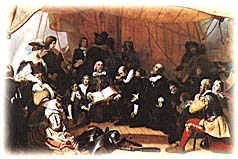
 After a prayer service, the Pilgrims began building hasty shelters. However, unprepared for the starvation and sickness of a harsh New England winter, nearly half died before spring. Yet, persevering in prayer, and assisted by helpful Indians, they reaped a bountiful harvest the following summer.
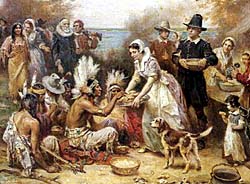 Pilgrim Edward Winslow described the Pilgrims' Thanksgiving in these words:
 Lincoln's original